
Living in a rural area no longer automatically means putting up with slow broadband.
While some countryside homes still rely on older copper phone lines, millions of rural properties can now access Full Fibre, 4G and 5G home broadband, fixed wireless networks and even satellite internet.
Thanks to ongoing investment from Openreach, Project Gigabit and independent fibre providers, broadband availability across rural Britain continues to improve every year.
The challenge isn’t simply finding an internet provider. It’s understanding which broadband technologies are available at your address and choosing the best option for your needs.
In this guide, we’ll explain the different broadband options available in rural areas, compare their advantages and disadvantages, and show you how to find the best broadband available where you live.
Why Is Broadband Slower in Rural Areas?
Broadband speeds in rural areas are often slower because of geography rather than the internet provider itself.
Many countryside homes are located much further from telephone exchanges or street cabinets than properties in towns and cities.
Traditional broadband technologies such as ADSL and Fibre to the Cabinet (FTTC) rely on copper telephone lines for part of the connection, and those speeds naturally decrease over longer distances.
Check Rural Broadband Availability at Your Address
Enter your postcode to see which rural broadband providers serve your property, compare available technologies, and discover the fastest broadband available where you live.
Another challenge is population density. Extending fibre infrastructure across sparsely populated areas is significantly more expensive than connecting thousands of homes within a city, which is why rural communities have historically received upgrades later than urban areas.
Fortunately, this is changing rapidly. Openreach continues expanding its Full Fibre network across the UK, while Project Gigabit is helping fund broadband improvements in harder-to-reach communities. At the same time, independent fibre providers are building their own networks specifically for rural towns and villages.
Today, many rural households can already access gigabit-capable broadband that would have seemed impossible just a few years ago.
What Broadband Options Are Available in Rural Areas?
The best broadband technology depends entirely on where you live. Some rural homes have multiple options available, while others may need to consider alternative technologies.
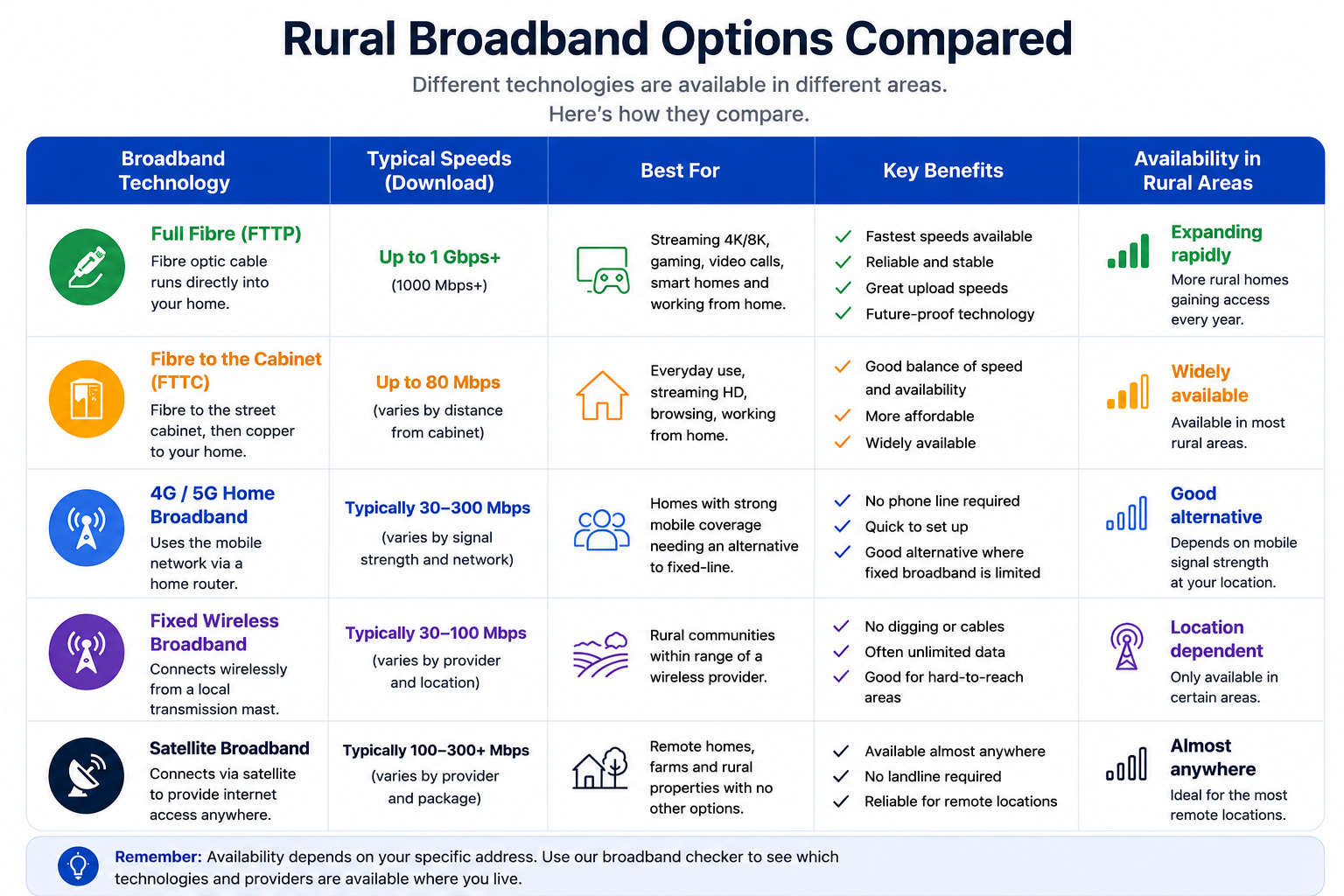
Full Fibre (FTTP) is the fastest and most reliable broadband technology available today. Fibre runs directly into your property, delivering faster download and upload speeds, lower latency and a more stable connection. If it’s available at your address, it’s almost always the best option.
Fibre to the Cabinet (FTTC) remains one of the most common technologies across rural Britain. Fibre runs to the street cabinet before switching to existing copper lines for the final connection. Speeds vary depending on how far your home is from the cabinet.
ADSL is still available in some rural locations but is now considered outdated. It may be suitable for light browsing and emails but can struggle with streaming, gaming and working from home.
4G and 5G home broadband provide another excellent option where mobile coverage is strong. Instead of relying on fixed telephone lines, a home router connects to the mobile network, often delivering much better performance than older copper connections.
Satellite broadband has also evolved significantly. Services such as Starlink make it possible for remote farms and countryside properties to enjoy high-speed internet even where fixed-line infrastructure doesn’t exist.
Fixed wireless broadband is another alternative in certain rural communities, delivering broadband wirelessly from a nearby transmission mast.
The Best Broadband Providers for Rural Areas
There isn’t a single broadband provider that’s best for every rural home. Unlike towns and cities where most providers are widely available, broadband coverage in rural areas can vary dramatically between neighbouring villages and even between properties on the same road.
The best provider depends on which network serves your address. Before comparing prices or speeds, it’s worth checking which broadband technologies are actually available where you live.
If your home is connected to the Openreach network, you’ll often have a choice of several well-known broadband providers, including:
- BT – Wide range of Full Fibre packages with speeds up to 900 Mbps.
- EE – Offers Full Fibre broadband alongside mobile bundles and speeds up to 1.6 Gbps in selected areas.
- Sky – Popular choice for customers looking to bundle broadband and TV services.
- Plusnet – Known for straightforward pricing and reliable customer support.
- TalkTalk – Competitive pricing across both FTTC and Full Fibre packages.
- Vodafone – Fast Full Fibre plans with regular promotional offers.
- Zen Internet – Premium broadband provider with excellent customer satisfaction ratings.
All of these providers use the same Openreach infrastructure where available, so differences usually come down to pricing, customer service, contract length and any extras included with your package.
Some rural communities are also served by independent fibre providers that have focused specifically on connecting smaller towns and villages.
Depending on where you live, you may also find providers such as:
- Gigaclear
- B4RN
- Quickline
- Highland Broadband
- County Broadband
- Jurassic Fibre
These providers operate their own fibre networks rather than using Openreach’s infrastructure and often deliver gigabit-capable broadband in locations that previously had very limited internet options.
Can You Get Full Fibre in Rural Areas?
Yes, and the number of rural homes with access to Full Fibre is growing every year.
For many years, fast broadband was largely limited to towns and cities because extending fibre infrastructure across sparsely populated areas was expensive. As a result, many rural communities continued relying on older ADSL and FTTC connections long after urban areas had begun upgrading to fibre.
Today, that picture is changing.
Openreach continues expanding its Full Fibre network across the UK, while the government’s Project Gigabit programme is helping bring gigabit-capable broadband to harder-to-reach communities. At the same time, independent network providers such as Gigaclear, B4RN and Quickline are building fibre infrastructure specifically for rural towns and villages.
This means many countryside homes that previously struggled to stream HD video or support multiple users online can now access broadband speeds of 500 Mbps, 900 Mbps or even faster.
Of course, rollout is still ongoing, and availability varies significantly depending on where you live. Some villages already have multiple Full Fibre providers to choose from, while others may still be waiting for future upgrades.
The quickest way to find out whether Full Fibre is available at your address is by running a postcode check.
How to Choose the Best Broadband
Finding the right broadband package isn’t simply about choosing the fastest advertised speed.
The best broadband for your home depends on how you use the internet, how many people live in the property and which technologies are available where you live.
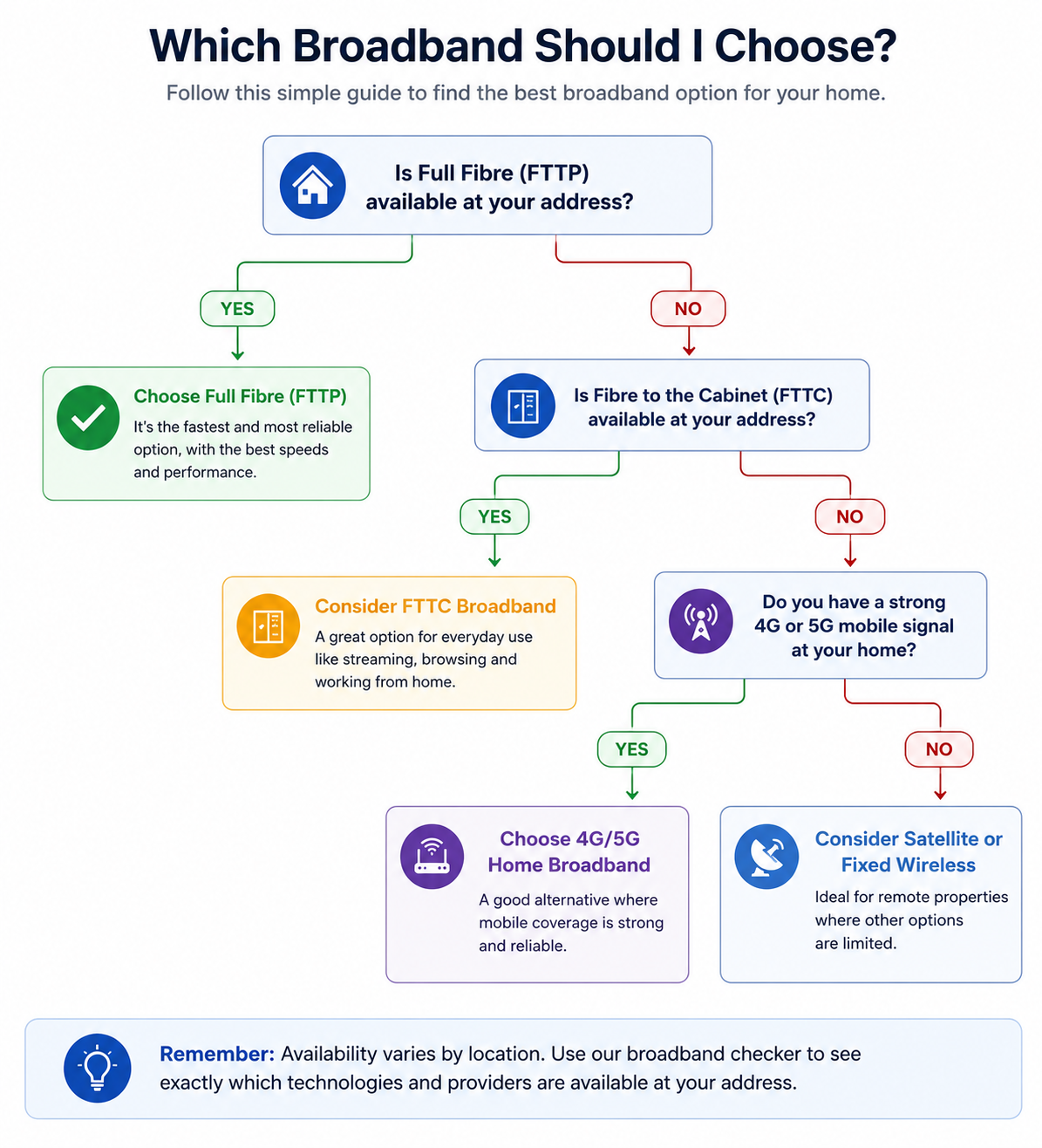
Before choosing a provider, consider the following:
- Prioritise Full Fibre where available. If your property can access FTTP, it’s usually the fastest and most reliable option.
- Choose a speed that matches your household. A single person checking emails doesn’t need the same package as a family streaming 4K content while working from home.
- Compare guaranteed speeds, not just advertised speeds. Providers often advertise “up to” speeds, but guaranteed minimum speeds provide a better indication of real-world performance.
- Think beyond price. A slightly more expensive package may include better customer support, shorter installation times or faster upload speeds.
- Check contract length. Some providers offer flexible rolling contracts, while others require commitments of 18 or 24 months.
Taking a few extra minutes to compare providers can help you avoid paying more than necessary while ensuring your broadband keeps up with your household’s needs.
How to Check Broadband Availability in Rural Areas
Broadband adverts often highlight impressive headline speeds, but they rarely tell you whether those packages are actually available where you live.
That’s because broadband availability depends on the infrastructure serving your property rather than your postcode alone. Two neighbouring homes can sometimes have access to completely different broadband technologies depending on how they’re connected to the network.
Instead of guessing, use our broadband availability checker to see exactly what’s available at your address.
In just a few seconds, you’ll be able to:
- Compare broadband providers available at your property.
- See whether Full Fibre, FTTC or other technologies are available.
- View estimated broadband speeds.
- Compare current broadband packages.
- Find the fastest broadband available for your home.
Whether you live in a small village, on a farm or in a remote countryside location, checking your address first is the easiest way to find the best broadband available.
The Future of Rural Broadband
Over the past decade, rural broadband has improved dramatically, and that progress is expected to continue.
Openreach is expanding its Full Fibre network across the UK, while Project Gigabit is helping bring gigabit-capable broadband to some of the country’s hardest-to-reach communities. At the same time, independent fibre providers continue investing in rural towns and villages that have traditionally been underserved.
For homes where laying fibre isn’t practical, technologies such as fixed wireless and low-Earth orbit satellite services like Starlink are helping close the digital divide. Together, these technologies are giving more rural households access to faster and more reliable internet than ever before.
While not every community will receive Full Fibre at the same pace, the gap between urban and rural broadband continues to narrow. For many households, the question is no longer if faster broadband is coming, but when.